Forest Walks & Apple Orchard Experience in Kufri | Vedanta
Private forest walks and apple orchard access for Vedanta guests in Kufri — seasonal harvest detail, best months, and a nature retreat generic hotels can't offer.
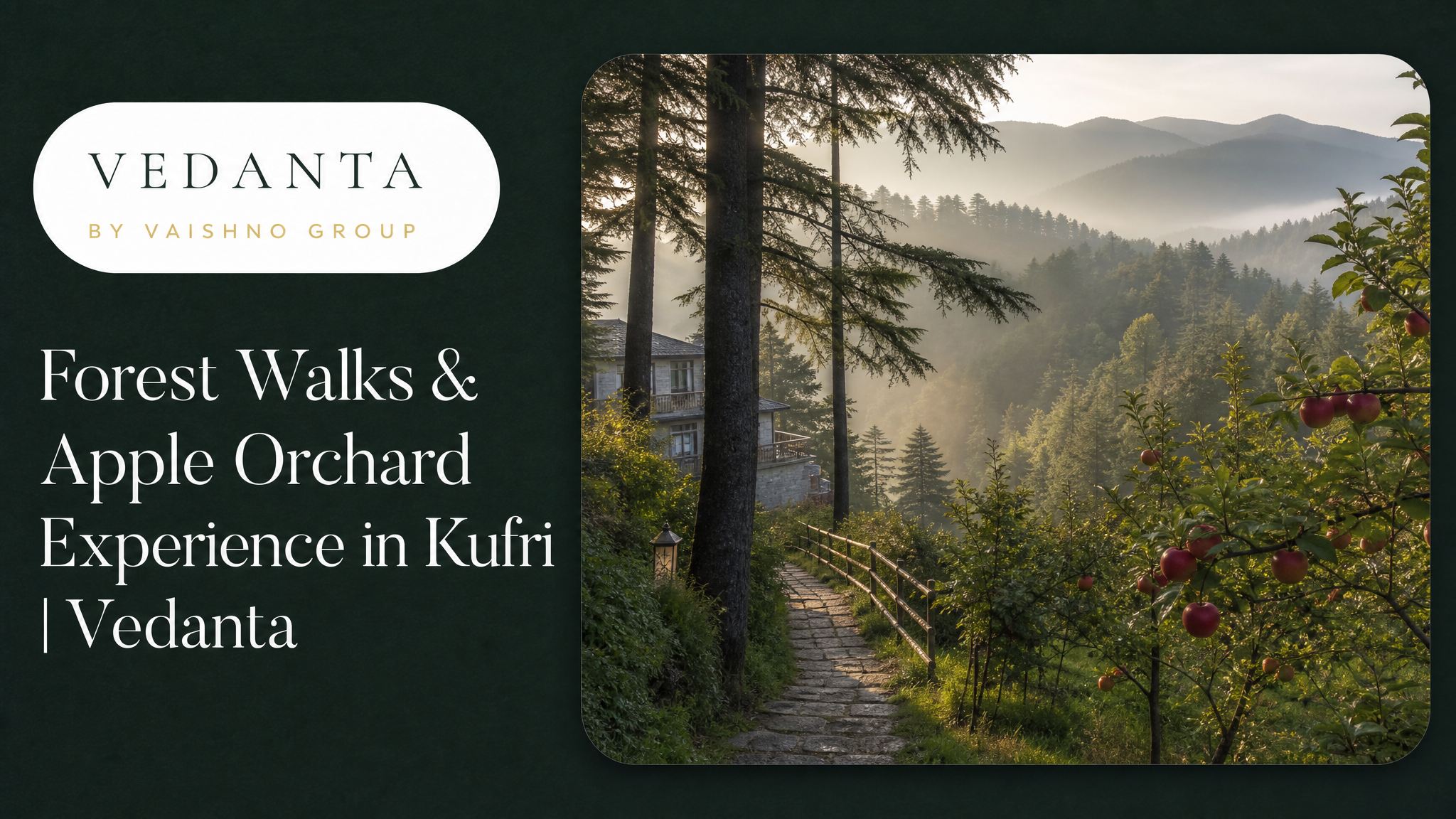
Most people who book a hillside stay in Kufri get handed a printed sightseeing itinerary and a shared taxi slot. At Vedanta, the forest walks start at the edge of the property, and the orchard belongs to the villas, not to someone else's tour route. Guests staying here don't travel to see nature — they wake up inside it, and the forest walks Kufri offers from this particular address happen on private, resident-only ground: no shared trailheads, no queue of day-trippers, no bus idling at a viewpoint car park. This page walks through both experiences in detail — the trail itself, the orchard's seasons, a sample day that strings them together, and the specific months worth planning around.
Why Vedanta's Nature Experience Is Different. Almost every hotel in Shimla and Kufri sells the same version of "nature." A concierge books you onto a shared jeep, you're dropped at a public viewpoint alongside forty other tourists, you take the same photo everyone else takes, and you're back by lunch. It's sightseeing, packaged and timed, and it's the only version most properties can offer — because they don't own any land beyond their building footprint.
Vedanta's forest trail and apple orchard sit on the property itself. That's a structural difference, not a marketing one: a hotel that doesn't own adjoining forest or orchard land simply cannot manufacture this experience, no matter how good its brochure copy is. There's no gate to share with outside visitors, no schedule to coordinate around a tour operator, and no other group of guests competing for the same morning light on the same trail.
For couples on a romantic getaway, that privacy is the point — a walk where you don't pass another soul, an orchard where the only footsteps are yours. For families, it means children can wander a little, elderly parents can walk at their own pace, and nobody's rushing anyone back to a coach. It's worth reading why Kufri is the quietest escape from Shimla (https://www.vedantabyvaishnogroup.com/blogs/why-kufri-is-the-quietest-escape-from-shimla) if this kind of quiet is what you're actually after — the forest and orchard are the clearest expression of that quiet on the ground.
The Private Forest Walk. The trail runs through mixed deodar and pine cover, the kind of dense, high-altitude forest Kufri is known for, and it stays cool and shadowed even when the sun is strong elsewhere on the property. Underfoot it's mostly packed earth and pine needles, gently sloped rather than steep, which makes it manageable for most fitness levels without feeling like a stroll through a manicured garden.
Early mornings bring a thin mist that sits low between the trees until the sun burns through it, usually within the first hour of daylight. Birdsong is constant — Himalayan bulbuls, the occasional woodpecker's drumming, and if you're quiet and lucky, a barking deer moving somewhere off the path. In the evenings the light turns amber and slanted, filtering through the pine canopy in a completely different mood than the crisp blue-grey of a dawn walk.
Because the trail belongs to the property, there's no shared right-of-way with day-tourists heading to nearby viewpoints — it isn't a public path that happens to run near a hotel, it's ground guests have to themselves. A full loop takes roughly 35–45 minutes at an easy pace, making it realistic before breakfast or as a wind-down after dinner. Bring a layer regardless of season — mornings run cold even in summer — sturdy flat shoes rather than sandals, and a phone or camera, because the light here changes fast enough that the same stretch of trail looks different twenty minutes apart. You can see photos of the forest trails and orchard (https://www.vedantabyvaishnogroup.com/gallery) to get a sense of what a given morning or evening actually looks like before you go.
The Apple Orchard Experience. Kufri and the surrounding Shimla hills are part of Himachal's established apple belt, and Vedanta's own orchard is a working piece of that landscape rather than a display garden. It's planted with a mix of varieties common to the region, and unlike a public farm visit where you're kept to a marked path and a ticket window, guests here can walk directly among the trees, stand under the branches, and — depending on the season — pick fruit by hand.
This is the core of what makes it an apple orchard experience Himachal visitors rarely get in this form: it isn't a bus stop between two other attractions, it's the property's own orchard, and access is limited to people actually staying at Vedanta. In blossom season the trees are a soft wash of white and pale pink against the darker forest behind them. In harvest season the air genuinely smells different — a faint, sweet fermented note that hangs around the rows once the fruit starts ripening properly, distinct from anything you'd notice walking past a market stall. Apples picked here can end up used in-house too, so there's a real orchard-to-table thread running from what guests pick to what shows up, in some form, at breakfast or in a dessert later that day.
Best Months for Blossom vs Harvest. If blossom photography is the goal, plan for March to April — this is when the orchard is in full bloom and the trees are at their most photogenic, usually a week or two before the wider hillside greens up. If hand-picking apples is the priority, August through October is harvest season across Himachal's apple belt, a window well documented in regional agricultural records on Himachal's apple harvest season (https://pmc.ncbi.nlm.nih.gov/articles/PMC3813512/), and it lines up with when Vedanta's own trees are ready.
Outside those two windows, the orchard doesn't shut down — it just changes character. Through the monsoon months the rows turn a deep, saturated green, and in winter, snow settles on bare branches for a stark, quiet kind of scenery that's its own reason to walk through. There's no dead season here, only a different mood depending on when you arrive.
A Sample Day: Forest, Orchard, and Quiet. A day built around this side of Vedanta doesn't need much planning, which is exactly the appeal. It might start with a dawn forest walk while the mist is still low and the light is grey-blue and soft — thirty-five minutes, no itinerary, back before the property's kitchen has even finished laying out breakfast. Breakfast itself happens at an unhurried pace, often with a view back toward the treeline you just walked through.
Later in the day, once the sun's higher and the orchard's warmed up, that's the natural time to wander down among the apple trees — whether that means photographing blossoms in spring or filling a small basket in harvest season. There's no fixed slot for this; it happens when guests feel like it, which is really the whole point of a nature retreat Kufri visitors choose Vedanta for instead of a scheduled sightseeing package. The day tends to close on the villa deck as evening light drops through the pine cover one more time, this time in gold rather than grey. It's a rhythm, not a checklist — closer to what a private Himalayan retreat should feel like (https://www.vedantabyvaishnogroup.com/blogs/what-a-private-himalayan-retreat-should-feel-like) actually describes than anything sold as a "sightseeing day" elsewhere in Kufri. Guests staying in Vedanta's private villas overlooking the orchard (https://www.vedantabyvaishnogroup.com/luxury-villas-in-kufri) get this rhythm as a default, not an upgrade.
Photography & Sensory Moments Guests Love. The moments that end up on guests' phones aren't staged — they're the small, specific things this kind of access makes possible. Dew sitting on a blossom petal at 7am before anyone else has walked past it. Sunlight breaking through the pine canopy in individual shafts, not the flat overcast light you get at a crowded public viewpoint mid-morning. The particular pink-orange of dusk settling behind rows of apple trees in late September, right as harvest is winding down.
None of this requires a professional camera. A phone held steady during that first hour after sunrise, when the mist hasn't fully lifted and the light is still soft and directional, will outperform a midday shot from any public lookout point nearby. The advantage isn't better light in some abstract sense — it's having the trail and the orchard empty enough to actually compose a shot without three other groups walking into frame.
Best Time of Year to Visit for This Experience. Thinking specifically about the forest and orchard, rather than Kufri in general, the year breaks into four fairly distinct windows. Spring (March–April) is blossom season in the orchard and also when the forest floor starts showing new undergrowth after winter — arguably the single best stretch for photography. Summer (May–July) brings the mildest, most comfortable walking weather, with the forest at its most lush and green, though this is before fruit has properly formed. Monsoon (July–August) turns everything a deeper, saturated green and the mist in the forest gets thicker and lingers longer, which some guests actually prefer for atmosphere over clear visibility. Autumn (August–October) is harvest time in the orchard and also when the forest light turns crisp and golden — arguably the most complete version of this experience, since both the orchard and the trail peak at once. Winter (December–February) strips it back to something starker: snow-laced branches, quiet forest walks in cold, clean air, and an orchard that's dormant but scenic in its own bare way.
For a broader look at planning a stay around weather, festivals, and general travel logistics rather than the nature experience specifically, the best time to visit Kufri for a private stay (https://www.vedantabyvaishnogroup.com/blogs/best-time-to-visit-kufri-for-a-private-stay) guide covers that ground in more depth.
Frequently Asked Questions. Is the orchard open to non-residents? No. The orchard and forest trail are part of Vedanta's private grounds and are reserved exclusively for guests staying at the property. There's no day-visit ticket or walk-in access, which is exactly what keeps the trail and the trees free of outside foot traffic.
What is the best month to see apple blossoms? Late March into April is typically the peak blossom window, though the exact timing can shift by a week or two depending on that year's winter. If blossom photography is your priority, aim to book within that window rather than the broader spring season.
Is the forest walk guided or self-guided? It's self-guided by default, since the trail is short, clearly defined, and safe to walk independently at any hour the property is open. Guests who'd prefer company or local context can arrange a guided walk with staff on request.
Is it suitable for families with children or elderly guests? Yes. The trail is gently sloped rather than steep, the loop is short enough to shorten further if needed, and there's no set pace to keep up with since it's private and self-timed. Families often break the walk into two shorter outings rather than one long one.
Do guests get to keep or eat the apples they pick? Yes, during harvest season guests can hand-pick apples and keep what they gather. Some of the orchard's fruit is also used in-house, so it isn't unusual to see the same apples turn up in a breakfast dish or dessert later the same day.
If any of this has you thinking about dates, the simplest next step is to enquire about a stay at Vedanta (https://www.vedantabyvaishnogroup.com/contact) and ask directly about orchard conditions for the week you have in mind — blossom and harvest timing shift slightly year to year, and the team on the ground will know exactly where things stand.