Vedanta's Private Mansion Collection: A New Kufri Story
Discover why Vedanta's private mansion collection in Kufri is a fresh story in Himalayan luxury travel — a angle press and travel editors haven't covered yet.
Every hill station eventually gets the same write-up. A heritage property with colonial-era charm. A resort chain with a spa menu and a mountain-view restaurant. A "best luxury hotels in Shimla" listicle that rotates the same six names depending on who paid for the photography. Kufri, tucked into Himachal Pradesh's hill country eleven kilometers from Shimla and considerably quieter, has mostly escaped that treatment — until recently.
Vedanta's private mansion collection is not another entry for that listicle. It's a different model entirely — a luxury villa retreat built around whole-property stays rather than shared resort inventory, with individually designed villas standing in for hotel rooms. That distinction sounds small until you look at what it actually changes about how a traveler experiences the mountains — and why it gives travel editors and bloggers a story that the hotel-and-resort establishment structurally cannot tell.
Why Kufri's Luxury Hotel Scene Looks the Same Everywhere Else
Walk through the upper reaches of Shimla and Kufri and the pattern repeats itself. A heritage building or resort chain acquires a hillside plot, builds forty to eighty rooms around a central lobby, and furnishes each one from the template that defines most Himachal luxury stays today — exposed wood beams, a mountain-facing balcony, a spa treatment list borrowed from whichever wellness consultant was hired that season. Guests share a dining room, a reception desk, a parking lot, and — inevitably — the noise of everyone else's holiday.
This isn't a criticism of the hotels themselves; it's simply the economics of the room-based model. Profitability depends on occupancy across dozens of rooms, which means common areas, shared staff rotations, and amenities designed for the average guest rather than any individual one. It's a perfectly good model for volume. It is not, by design, a private one.
That's the gap. Nobody else in the Kufri-Shimla corridor is offering a curated collection of independent, whole-villa mansions where the property you book is the only one you occupy — genuine Kufri private villas, not villa-branded hotel suites. The absence isn't an oversight — it's simply outside what the room-based model can offer.
What a 'Private Mansion Collection' Actually Means
A private mansion collection means exactly what the words say: a set of individually designed villas, each with its own architecture, layout, and character, grouped under one curated brand rather than standardized into identical room types.
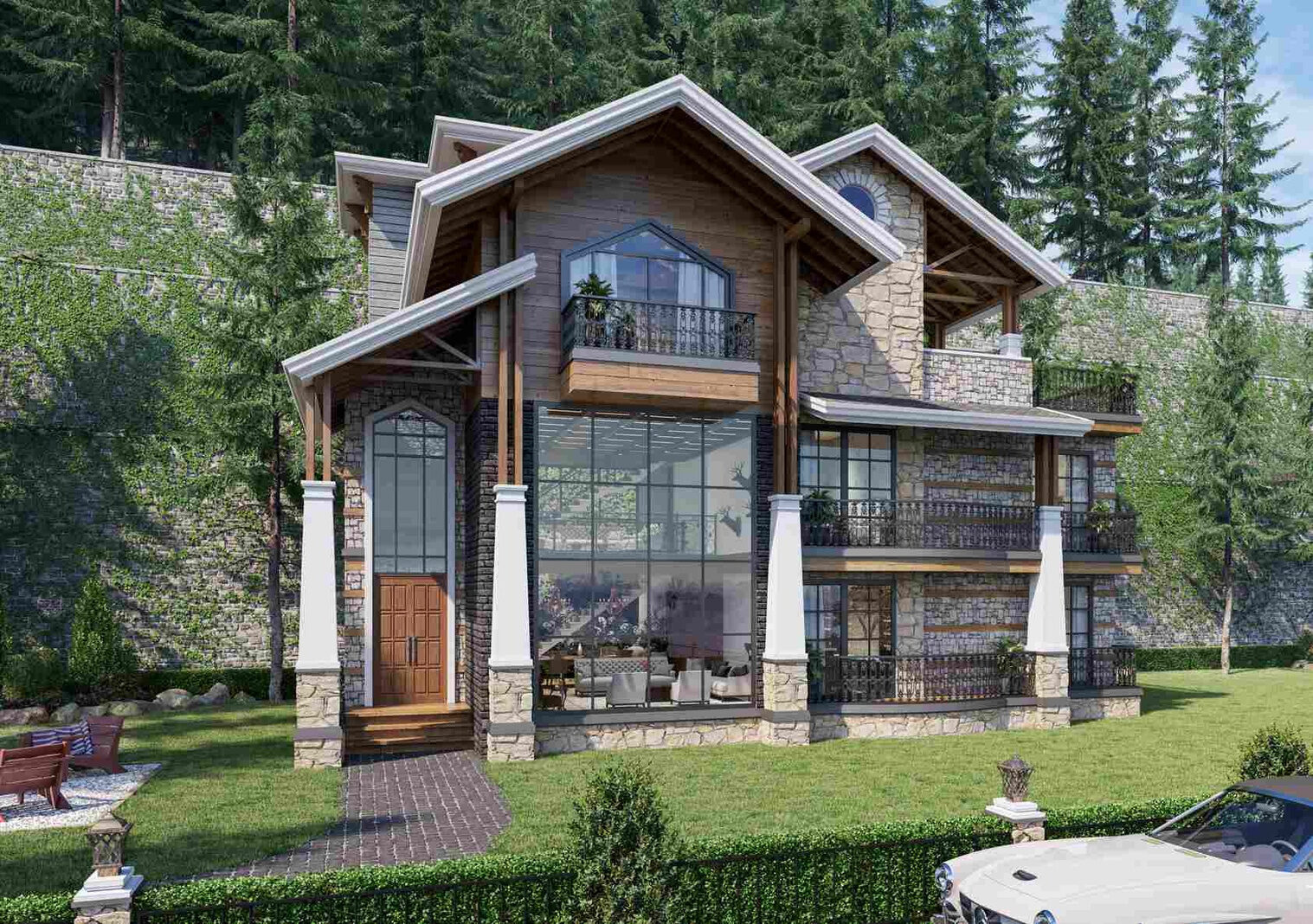
Vedanta's collection consists of a small number of distinct residences and villas — not dozens of interchangeable rooms — each built with its own footprint, material palette, and relationship to the surrounding pine forest. Booking one means the entire structure is yours: no shared lobby, no adjoining rooms, no other guests moving through common corridors. The unit of stay is the mansion, not the bed.
This matters for the kind of E-E-A-T signal that actual travel writers and researchers look for before citing a property: specificity over adjectives. Rather than describing the collection as "unparalleled" or "world-class" — words that could describe literally anything — the more useful facts are structural: how many villas exist, how they're designed, and what exclusivity actually means on the ground. You can see the real inventory on Vedanta's Residences & Villas collection page (https://www.vedantabyvaishnogroup.com/villas), and the physical character of each property is documented in the gallery of Vedanta's private villas (https://www.vedantabyvaishnogroup.com/gallery) — both useful references if you're building out a feature or a listing.
The Story Behind the Collection: Origin and Design Philosophy
Every luxury property claims a philosophy. Fewer can point to the specific problem that philosophy was built to solve. Vedanta's origin story is grounded in a fairly ordinary observation about Himalayan hospitality: the region has plenty of scenic hotels, but very few that operate as a genuinely private Himalayan retreat, where a guest can hold an entire mountainside experience — the silence, the view, the architecture — without sharing it with strangers passing through a shared lobby.
The choice of Kufri over the more obvious Shimla address was deliberate. Shimla's Mall Road and Ridge area draw the tourist volume; Kufri sits far enough outside that gravitational pull to stay genuinely quiet, while remaining close enough to be a practical base for a mountain trip. Building a collection of private mansions there — rather than another hotel wing in central Shimla — was a bet that travelers seeking real seclusion would rather drive twenty extra minutes than fight for a quiet table at breakfast.
The design brief that followed wasn't "build luxury rooms." It was closer to "solve for noise, crowding, and sameness" — the three complaints that recur most often in reviews of generic hill-station luxury. Each villa in the collection was designed as its own architectural statement rather than a repeatable unit, which is precisely why the collection reads as a set of mansions rather than a hotel with a nicer name.
Why This Is a Fresh Angle for Travel Press and Bloggers
For a travel editor, "best resort in Shimla" is a saturated brief — the same five or six properties rotate through every roundup, differentiated mostly by which one has the newest infinity pool. A model built entirely around private, whole-villa exclusivity is a different pitch: it's a story about a category, not just another entry in one.
That's useful for several kinds of coverage simultaneously. Architecture and design writers have a genuine build story to work with — materials, siting, acoustic design. Lifestyle and wellness journalists have a stay-based wellness angle that isn't tied to a spa menu. And travel writers covering the broader slow-travel and privacy trend — a well-documented shift in post-2020 luxury travel toward exclusive-use properties over shared resorts — have a concrete regional example to point to, one that shows what luxury travel Himachal Pradesh looks like beyond the standard hotel format. Kufri, positioned against Shimla's more crowded tourist core, adds a geography angle on top of the architecture and wellness ones.
A Design Story: Silence, Privacy, and Architecture
The collection's design philosophy centers on acoustic and visual privacy as deliberately engineered outcomes, not incidental byproducts of being in the mountains. Villa siting accounts for sightlines to neighboring properties, material choices are selected in part for how they dampen sound, and layouts are built around the idea that a guest should be able to spend an entire stay without hearing another party's conversation. It's a level of specificity that's covered in more depth in how Vedanta designs for silence inside a Himalayan villa (https://www.vedantabyvaishnogroup.com/blogs/designing-for-silence-inside-a-himalayan-villa) — a useful reference for any piece built around the architecture angle specifically.
A Wellness Story: Beyond the Spa Menu
The wellness angle here isn't a treatment list bolted onto a hotel stay — it's structural, built into how a villa stay unfolds across a day.