
Weekend Getaway Shimla: Kufri Season by Season Guide
Planning a weekend getaway to Shimla? See how each Kufri season shapes your private villa stay — snow, orchard bloom, monsoon mist or autumn — and pick your best time to visit.
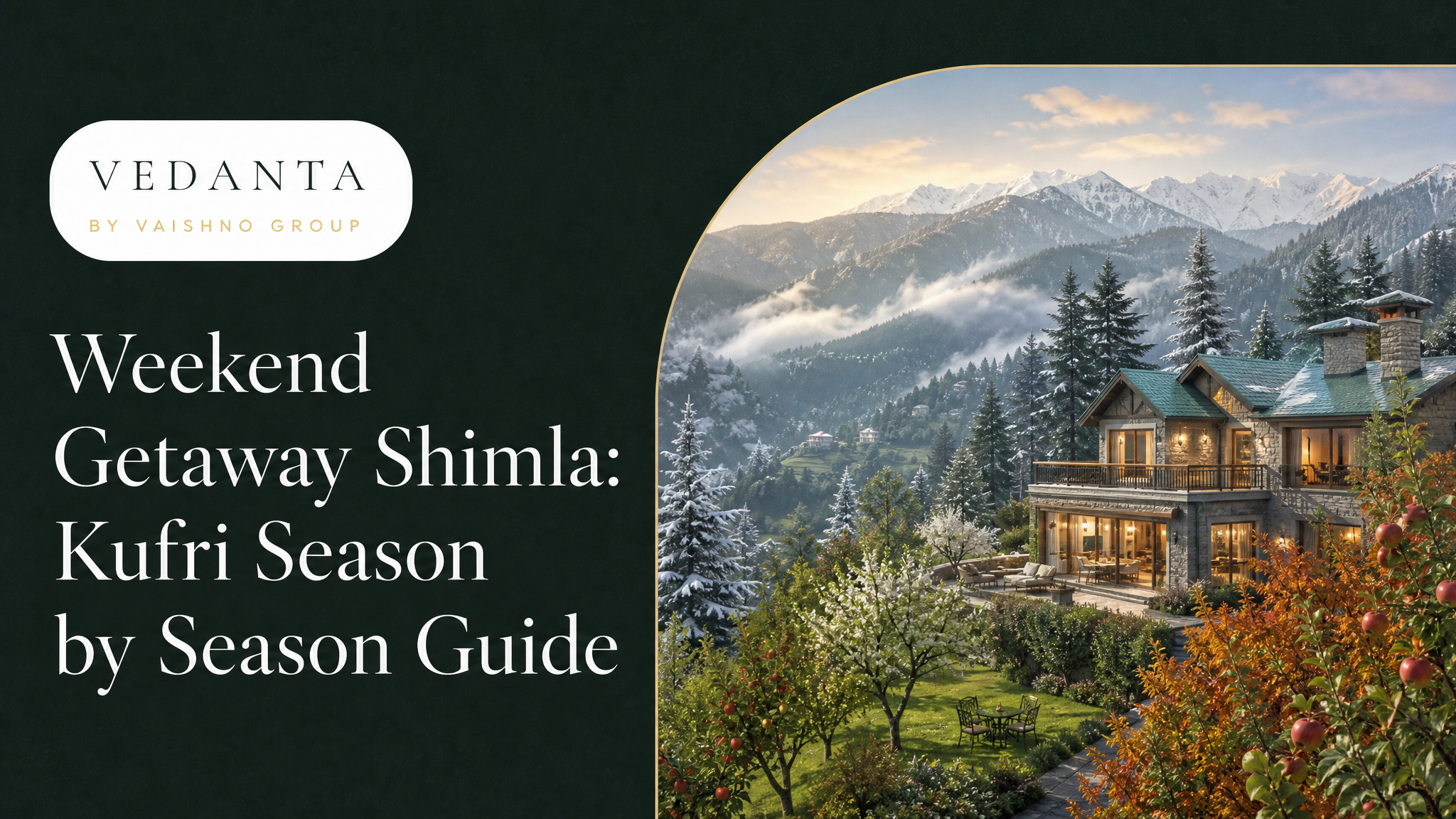
Most people planning a weekend getaway to Shimla ask the wrong first question. They ask "what should we see," when the question that actually determines whether the trip works is "what time of year are we going." Kufri, the quiet hill above Shimla town, changes completely across the year — not just in temperature, but in what a short trip there actually feels like. A December weekend by a fireplace with snow on the deodars outside your window is a different holiday than a June afternoon walking through orchards in cool mountain air, which is different again from an October morning watching apple pickers work rows of trees under a clear Himalayan sky.
This guide is built around that idea. Instead of listing attractions that stay the same all year, it maps each season at Kufri to the kind of weekend it actually delivers — and to the private villa and orchard experience that shapes it — so you can pick your dates around the trip you actually want, not just the trip that's available.
Why Season Matters More Than the Destination for a Kufri Weekend. Search "things to do in Shimla" and you'll get the same list regardless of when you're going — Mall Road, the Ridge, Jakhu Temple, the toy train, a day trip to Kufri for the ropeway and the snow point. None of it tells you whether your specific weekend will be warm or freezing, crowded or empty, blooming or bare.
That gap matters more for Kufri than for most hill destinations, because a weekend trip here is short — typically two nights, sometimes three. There's no room to "wait out" bad weather or a closed road the way you might on a ten-day trip. Whatever the season is doing when you arrive is the trip you're going to have. A private villa stay makes this even more pronounced: when your evenings are spent on a terrace, in a garden, or by an orchard rather than moving between hotel lobbies and restaurants, the season isn't a backdrop to your trip — it's most of the experience.
That's the lens for the four sections ahead: winter, summer, monsoon, and autumn, each mapped to what a weekend at private villas at Vedanta (https://www.vedantabyvaishnogroup.com/luxury-villas-in-kufri) actually looks like during that window. Worth bookmarking this one — since Kufri's character shifts every few months, it's a guide you'll likely want to revisit each time you're planning your next trip rather than something you read once.
Winter in Kufri: Snow Season Weekend Getaway (Dec–Feb). Kufri sits higher than Shimla town, which means it tends to catch snow earlier and hold it longer — often when Shimla itself is only seeing rain or slush. Snowfall is likeliest from late December through February, with January generally the most reliable month if snow is the whole point of your trip.
A winter weekend Shimla getaway built around Kufri looks very different depending on where you stay. The public snow point near Kufri gets busy fast on weekends — coach parties, queues for yak rides and sledging, a lot of noise for what's meant to be a quiet escape. A private villa weekend flips that entirely: snow visible from your own room, a fireplace instead of a shared lounge, breakfast timed to whenever you actually wake up rather than a buffet schedule. For couples or small groups from Delhi or Chandigarh who want the feeling of a proper winter escape without committing to a long Himachal circuit, this is the version of Kufri that delivers it in two nights.
For a fuller sense of what that slower pace actually feels like day to day, a slow winter weekend at Vedanta (https://www.vedantabyvaishnogroup.com/blogs/a-slow-winter-weekend-at-vedanta) walks through one such stay in detail.
What to Pack and Expect. Expect daytime temperatures around 2–8°C and nights well below freezing, sometimes down to -2°C or colder after a snowfall. Pack proper thermal layers, waterproof shoes, and a warm jacket rather than relying on typical "Delhi winter" clothing — it's meaningfully colder than the plains at night.
Roads to Kufri are generally kept operational through the season, but a heavy snowfall can slow the last stretch of the drive, so building a little flexibility into your arrival time is sensible. For a two-night trip, the realistic plan is one full day near the villa — enjoying the snow, the views, the fireplace — rather than trying to fit in the snow point, Mall Road, and a day trip all in one weekend. Fewer stops, done properly, beats a rushed checklist.
Summer Escape: Kufri as a Cool-Climate Weekend Retreat (Mar–Jun). By the time Delhi and Chandigarh are hitting 40°C-plus afternoons, Kufri is sitting comfortably in the high teens to low twenties — genuinely usable outdoor weather rather than a slightly-less-hot version of the plains. This is what makes it work as a summer escape Kufri trip rather than just another hill-station stop: the temperature difference is large enough to be the actual reason for the trip.
March through June is Kufri's greenest stretch, with clear daytime skies, blooming gardens, and comfortable evenings — no need for heavy layering, just a light jacket after dark. It's also, predictably, the busiest booking window for weekend travel, since it lines up with school breaks and the worst of the plains' heat. Families and larger groups tend to do well here, since the season supports proper outdoor villa time — breakfast in the garden, evenings on the lawn, orchard walks in daylight that a winter trip simply doesn't allow. If your plan involves actually using a villa's outdoor spaces rather than sheltering from the cold, this is the window to book in advance, since the best dates go early.
Monsoon in Kufri: The Quiet, Underrated Season (Jul–Sep). Most Shimla content skips monsoon entirely, or mentions it only as a warning. That's a missed window, not a season to avoid outright — it just needs a more honest treatment than "come anytime, it's beautiful."
Monsoon Kufri means mist rolling over the valley in slow waves, deep green hillsides, and a stillness that the peak seasons simply don't have. Tourist numbers drop sharply, which means quieter roads, easier access to a private villa's grounds, and rates that are noticeably lower than summer or winter peak pricing. For travelers who want solitude — long mornings with coffee and fog on a private balcony, photography without a dozen other people in the frame — this is arguably the most underrated season on this list.
It does need caveats, though, and glossing over them would be dishonest. Himachal's monsoon roads carry real landslide risk, particularly after sustained heavy rain, and the Shimla–Kufri stretch is not immune to sudden closures or slow-moving traffic after a downpour. The safer approach is to avoid the heaviest weeks — usually mid-July through August — and lean toward early July or September, when rainfall is lighter and more predictable, for the best balance of mist-and-green atmosphere against road risk. Checking a live weather and road advisory a day or two before you leave is worth the five minutes it takes.
For more on why this quieter side of the season suits some travelers better than the crowded months, see why Kufri is the quietest escape from Shimla (https://www.vedantabyvaishnogroup.com/blogs/why-kufri-is-the-quietest-escape-from-shimla).
Autumn Orchard Season: Harvest Weekends in Kufri (Oct–Nov). If there's one season built for the private orchard-estate version of Kufri, it's autumn. October and November bring the apple harvest, clear post-monsoon skies, and some of the sharpest, most detailed Himalayan views of the year — the haze that softens summer views is gone, and the mountains sit crisp against the horizon most mornings.
This is where an autumn orchard Kufri stay stands apart from a generic hill-station weekend. Instead of a sightseeing checklist, the experience is walking through rows of apple trees mid-harvest, spending an evening with mountain air that's cool but not yet winter-cold, and having that entire setting as the backdrop to where you're actually staying rather than a stop on a day trip. It pairs naturally with the kind of slower, wellness-oriented stay that a villa property is built for — unhurried mornings, orchard-adjacent walks, evenings that don't need an itinerary. For a deeper look at that side of a Kufri stay, wellness in the mountains beyond the spa menu (https://www.vedantabyvaishnogroup.com/blogs/wellness-in-the-mountains-beyond-the-spa-menu) is worth reading alongside this section.
Because it falls between the summer rush and the winter snow crowd, autumn is also genuinely underrated as a booking window — good availability, comfortable weather, and a landscape actively changing week to week through the harvest.
So, When Is the Best Time to Visit Kufri for Your Trip? There isn't a single best time to visit Kufri — there's a best time for the trip you're actually planning.
Want a romantic, snow-lit couple's escape? Go in January, book a private villa over a hotel, and keep the itinerary light.
Traveling with family and want cool air, greenery, and outdoor space? March through June delivers reliable good weather, though it's worth booking well ahead given demand.
Craving solitude, mist, and a genuinely off-peak rate? Early July or September, with a road-condition check before you leave, gives you monsoon's atmosphere without its worst risk.
Want orchards, harvest, and the clearest mountain views of the year? October and November are hard to beat, and arguably the most underrated of the four windows.
For a more detailed breakdown built specifically around villa stays rather than general tourism, best time to visit Kufri for a private stay (https://www.vedantabyvaishnogroup.com/blogs/best-time-to-visit-kufri-for-a-private-stay) goes deeper into this exact question.
Planning Your Weekend at Vedanta. Whichever season you land on, the thread running through all four is the same: a hotel room gives you a view of the season, a private villa gives you the season itself, from your own terrace, garden, or orchard path, without sharing it with a lobby full of other guests. That's true of a fireplace in January as much as it is of harvest walks in October.
If you already know your season, the next step is simple — check dates at the private villas at Vedanta (https://www.vedantabyvaishnogroup.com/luxury-villas-in-kufri) and lock in your weekend before the good windows fill up, particularly for peak summer and winter dates. If you're still deciding between seasons, or want help matching a specific date range to what Kufri will actually look like then, enquire about your seasonal stay (https://www.vedantabyvaishnogroup.com/contact) and get a straight answer before you book.
Frequently Asked Questions.
What is the best month for snow in Kufri? January is generally the most reliable month for snow in Kufri, with snowfall often starting in late December and continuing into early February. Kufri tends to see and hold snow earlier than Shimla town itself due to its higher elevation, so a January weekend gives the best odds of a proper snow experience.
Is it safe to visit Kufri during monsoon? It can be, with some caution. Roads around Kufri and Shimla carry landslide risk during heavy monsoon downpours, especially mid-July through August. Traveling in early July or September, checking road advisories before you leave, and building flexibility into your travel time make a monsoon visit reasonably safe and genuinely rewarding.
How far is Kufri from Delhi and Chandigarh for a weekend trip? Kufri is roughly 370–390 km from Delhi (around 8–9 hours by road) and about 115–120 km from Chandigarh (roughly 4–5 hours), making it a realistic Friday-evening-departure or Saturday-morning weekend getaway from both cities.
How many days should I plan for a Kufri weekend getaway? Two nights is the minimum for a proper Kufri weekend, giving you one full unhurried day and two half-days for travel. Three nights is better if you want to actually slow down — one day for arrival and settling in, one full free day, and one day for orchard walks or a nearby excursion before heading back.
Is Kufri quieter than Shimla town? Yes, noticeably. Shimla's Mall Road and Ridge area get crowded year-round, especially on weekends, while Kufri — outside its public snow point and ropeway area — stays considerably quieter, particularly if you're based at a private villa away from the main tourist cluster.